
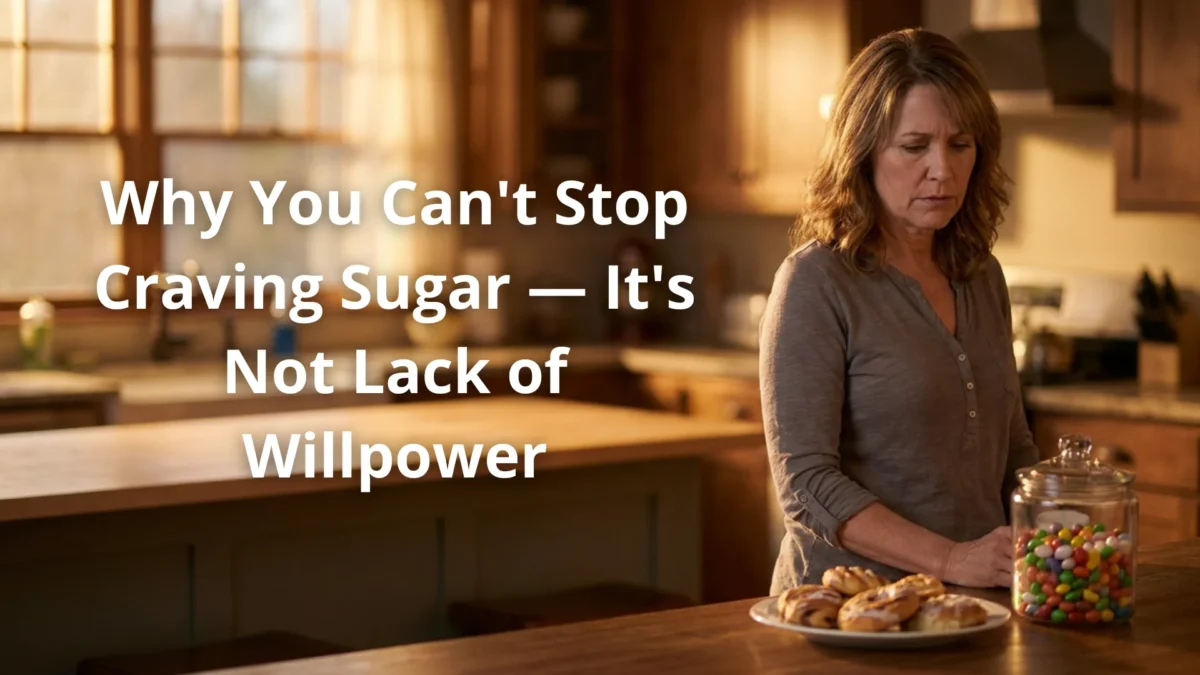
Blood sugar and sugar cravings often appear together, especially in adults over 40 who feel trapped in a cycle of energy crashes, snack cravings, and constant hunger. This article explores why sugar cravings may be connected to cellular glucose regulation and why researchers are paying close attention to GLUT4.
Sugar Cravings After 40 — Why Willpower Keeps Failing and What Biology Says Instead
If you constantly crave sweets, snacks, or carbohydrates even when you’re trying to eat better, the problem may not be discipline. Researchers believe there may be a deeper biological reason many adults over 40 feel trapped in the same craving cycle.

The Frustrating Cycle Most People Know Too Well
You promise yourself you’re going to eat better today.
Breakfast goes well. Lunch is fine. Then sometime during the afternoon or evening, the cravings start. Suddenly you’re thinking about cookies, chocolate, ice cream, chips, bread, or anything that delivers quick satisfaction.
You resist for a while. Sometimes you win. Sometimes you don’t. And when you give in, the same thought usually follows:
“Why is this so hard for me when other people seem to have control?”
Many adults blame themselves. They assume cravings are simply a lack of discipline. But a growing body of evidence in metabolic research is questioning whether willpower is really the main problem — or whether something biological is driving the cycle that no amount of determination can permanently override.
The Conventional Explanation Doesn’t Fully Explain Cravings
Most advice about sugar cravings focuses on habits: drink more water, eat more protein, avoid keeping sweets in the house, get more sleep. These recommendations can help at the margins. But they don’t explain something important.
Why do cravings often appear at the same times of day? Why do some people experience overwhelming urges even after eating what should have been a satisfying meal? Why do cravings become stronger as many adults move through their 40s and 50s — even when their eating habits haven’t changed dramatically?
The traditional explanation focuses on behavior and habit. Exercise physiologists and endocrinologists are increasingly focusing on biology instead. And what that research suggests is that for many adults over 40, the sugar cravings cycle may be driven by something happening at the cellular level — not the psychological level.
What Sugar Cravings May Be Trying to Tell You
Cravings are often treated like an enemy — something to resist, suppress, or overcome. But from a biological perspective, sugar cravings may actually be a signal. The body uses signals constantly: hunger is a signal, thirst is a signal, fatigue is a signal. The emerging view in metabolic research is that cravings may also be a signal that the body’s energy system is struggling to maintain balance.
In many people, cravings tend to appear alongside a recognizable cluster of other symptoms:
- Afternoon fatigue that arrives on schedule
- Brain fog after meals
- Energy crashes that coffee only temporarily fixes
- Difficulty concentrating in the early afternoon
- Feeling hungry again too soon after eating
The fact that cravings so consistently appear alongside these other symptoms suggests they may be connected to something much larger than simple preference or habit. They may all be pointing to the same root.

Why Sugar Cravings Often Get Worse After 40
Most people notice that managing energy, weight, and cravings becomes more difficult with age. The common explanation is that metabolism slows down. While partially true, that explanation is incomplete — and it doesn’t tell you what to do about it.
Researchers are increasingly focused on what happens to glucose transport as we age. One protein receiving significant attention is called GLUT4. GLUT4 helps move glucose from the bloodstream into cells where it can be used for energy. When this process works efficiently, energy tends to feel more stable and cravings are easier to manage. When the process becomes less efficient — as research shows happens progressively after 40 — cells aren’t receiving energy smoothly even when glucose is available in the bloodstream.
The body’s response to this cellular energy deficit is predictable: it sends stronger signals for quick energy sources. For most people, those signals show up as sugar cravings — specifically for sugar and fast carbohydrates, which represent the fastest available route to raising blood glucose. This may explain why cravings often become more persistent after 40 even when eating habits haven’t changed dramatically. The diet isn’t the primary problem. The cellular machinery processing it is.
Research published in the Journal of Clinical Endocrinology & Metabolism documented measurable age-related reductions in GLUT4 expression in skeletal muscle of non-diabetic adults — findings that researchers in metabolic medicine associate with increased glucose variability, energy instability, and the intensification of craving cycles in adults over 40. Read the study on PubMed →
The Missing Link Between Energy and Cravings
Most people think cravings start in the mind. Researchers increasingly believe many cravings may start in the body’s energy systems. When cells are not receiving energy efficiently, the body continues asking for more fuel — and that request often appears as a desire for sugar, because sugar represents one of the fastest available energy sources.
This creates a sugar cravings cycle that feels impossible to break through willpower alone:
Many people spend years trying to fight this cycle through discipline, substitution, and behavioral strategies — without ever understanding why it keeps reasserting itself. If the root is cellular glucose transport efficiency, behavioral strategies alone will always produce limited results.
What Researchers Are Investigating About GLUT4
Scientists studying glucose regulation have become increasingly interested in GLUT4 because it sits at a critical point in the body’s energy pathway. Its role is surprisingly direct: move glucose into cells. But researchers discovered that age, lifestyle, and metabolic changes may affect how efficiently that process works — and that this efficiency loss has broader consequences than previously understood.
The surprising implication is that symptoms many people think are unrelated — fatigue, cravings, hunger, and brain fog — may all be connected through the same cellular mechanism. What makes this discovery so important is that it shifts where researchers look for the root cause of the craving cycle. Not in the pantry. Not in willpower. In the cellular gateway that determines whether energy reaches the cells that need it.
Researchers identified a specific GLUT4-related pattern that may explain why some people experience relentless sugar cravings despite genuinely trying to eat healthier. The details of that discovery are changing how many experts think about blood sugar, energy regulation, and cravings after 40.
Related Reading
Maybe the Problem Was Never Willpower
If you’ve spent years blaming yourself for sugar cravings, you are not alone. Emerging research suggests the issue may be more biological than most people realize — and understanding the role of GLUT4 may completely change the way you think about cravings, energy, and blood sugar after 40.
Free presentation · Informational only · See affiliate disclosure below
This article is for informational and educational purposes only and does not constitute medical advice. The statements on this page have not been evaluated by the Food and Drug Administration. Products mentioned are not intended to diagnose, treat, cure, or prevent any disease. Individual results may vary. Always consult a qualified healthcare provider before starting any supplement regimen. This page contains affiliate links — if you purchase through them, we may earn a commission at no additional cost to you.